

Research on Colloidal Silver
by Robert C. Holladay
| Source: http://robholladay99.tripod.com/cs1index.htm |
*Opinions expressed by third-party sources are not necessarily those of Advanced Silver Co.
Research on Colloidal Silver
(One of the better compilations of silver research studies)
Some of the interesting highlights ...
 The
antimicrobial
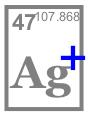
properties of silver are due to the silver ion...
(Romans, I.B. 1954. Oligodynamic metals. In Antiseptics, Disinfectants,
Fungicides, and Chemical and Physical Sterilization. Philadelphia, Lea
& Febiger, 388-428.)
The
antimicrobial
properties of silver are due to the silver ion...
(Romans, I.B. 1954. Oligodynamic metals. In Antiseptics, Disinfectants,
Fungicides, and Chemical and Physical Sterilization. Philadelphia, Lea
& Febiger, 388-428.)- Silver ions
are bactericidal, antifungal, protozoicidal, and active against herpes
simplex virus... (Russell, A.D., et al. 1994. Antimicrobial activity
and action of silver. Progress in Medicinal Chemistry, 31, 351-370.)
- Silver
sulfadiazine
is effective
against fungi. (Speck, William T., and Rosenkranz, Herbert
S. 1974. Activity of silver sulphadiazine against dermatophytes. The
Lancet, 895-896.)
- Among viruses
affecting the eyes, herpes simplex (HSV) and vesicular stomatitis
viruses (VSV) were found to be susceptible to direct inactivation by
this compound (silver
sulfadiazine). At 1 microgram/ml it suppressed
HSV growth I
tissue culture... (Tokumaru, T., Shimizu, Y., and Fox, C.L. Jr. 1974.
Antiviral activities of silver sulfadiazine in ocular infection.
Research Communications in Chemical Pathology and Pharmacology, 8(1),
151-158.)
- Silver
sulfadiazine
inactivates the infectivity of varicella zoster virus. “the
inhibitory action of the silver salt of sulfadiazine is
believed to be related to the presence of the silver ion”.
(Montes, Leopoldo F., Muchinik, Guillermo, and Fox, Charles L. 1986.
Response of varicella zoster virus and herpes zoster to silver
sulfadiazine. Cutis, 38, 363-365.)
- “Metal-binding
proteins are important components of retroviruses such as human
immunodeficiency virus (HIV). Therefore, metals
could be used as antiviral agents. However, most metals
are
toxic for humans with the
exception
of silver which is toxic only to
prokaryotic cells and viruses… (Hussain, Saber, Anner, Rolf M., and
Anner, Beatrice M. 1992. Cysteine protects Na, K-ATPase and isolated
human lymphocytes from silver toxicity. Biochemical and Biophysical
Research Communications, 189(3), 1444-1449.)
- “The drugs of
colloidal silver collargol and protargol were found to have activity
against the smallpox virus. (Bogdanchikova, N.Y., et al. 1992. Activity
of colloidal silver preparations toward smallpox. Pharmaceutical
Chemistry Journal, 26(9-10), 778.)
- “Ag+ solutions
exhibited better antimicrobial effectiveness against
bacteria, a yeast
species, and a mold than did analogous silver solutions from inorganic
salts (silver nitrate and silver chloride)…Ag+ could be used
effectively
in preservatives…the microbicidal activity of silver is significantly ion influenced
”. (Simonetti, N., et al. 1992. Electrochemical Ag+ for preservative
use. Applied and Environmental Microbiology, 58(12), 3834-3836.)
- “Silver, a
well-known antimicrobial agent, has been used in clinical settings for
more than a century. During this period, the safety
of this
agent has been well established… In addition to being
effective against
fungi, this method of silver application has also been demonstrated to
be effacious against a broad spectrum of bacteria, including
antibiotic-resistant strains… (Wright, J.B., et al. 1999. Efficacy of
topical silver against fungal burn wound pathogens. American Journal of
Infection Control, 27(4), 344-349.)
- "To be
bactericidal,
the silver
must be available as a solution, and the efficiacy of the
solution is dependent on the concentration of silver ions
present in the solution…silver is effective against a broad range of
antibiotic-resistant organisms, which is expected because silver has
been regularly found to be effective against antibiotic-resistant
organisms”. (Wright, J. Barry, Lam, Kan, and Burrell, Robert E. 1998.
Wound management in an era of increasing bacterial antibiotic
resistance: a role for topical silver treatment. American Journal of
Infection Control, 26(6), 572-577.)
- “Beginning in
1973,
in vitro studies demonstrated that such ions
were an effective antibiotic with a very broad spectrum
and favorable
quantitative evaluations compared with synthetic antibiotics…The
failure of other nontoxic metal ions to produce a similar alteration
with the same electrical parameters strongly indicates that the
electrically generated silver ion is the agent responsible
for the observed cellular changes…Healing rates in these wounds are
significantly accelerated and are accompanied by enhanced healing of
the bone, soft tissue, nerve, and skin, with replacement of missing
tissues by histologically normal tissues…The responsible agent for
these cellular effects is believed to be the electrically generated silver ion”.
(Becker, Robert O. 2000. Effects of electrically generated silver ions
on human cells and wound healing. Electro- and Magnetobiology, 19(1),
1-19.)
- Silver ions
were more effective at inhibiting bacteria than platinum,
gold, copper and stainless steel ions. (Spadaro, J.A., et al. 1974.
Antibacterial effects of silver electrodes with weak direct current.
Antimicrobial Agents and Chemotherapy, 6(5), 637-642.)
- “The Ag+
filler showed significantly more antibacterial activity than the
control filler without silver ions…The findings indicate that the
antibacterial effect is due to silver ions released from
the Ag+-containing filler.” (Yamamoto, Kohji, et al. 1996.
Antibacterial activity of silver ions implanted in silicone dioxide
filler on oral Streptococci. Dental Materials. 12: 227-229.)
- Electrodes
made from
stainless steel, platinum, gold, and silver were placed in dishes
containing bacteria. Current was applied. The
silver electrode offered superior inhibition. (Barranco,
S.D. et al. 1974. In vitro effect of weak direct current on
Staphylococcus Aureus. Clinical Orthopaedics and Related Research. 100:
250-255.)
- CS (colloidal silver)
manufactured by electrolysis
is superior to other methods of manufacture because it
produces a
pure product without by-products which might be difficult
to
separate. (Samaan, Karam. 1930. A comparison of the germicidal power of
colloidal metallic silver and of ionic silver. Quarterly Journal of
Pharmacy and Pharmacology. 3: 21-24.)
- It has been
shown
that the ionic
portion of a colloidal silver protein is the germicidal
component. (Sollman, Torald, and J.D. Pilcher 1924. Organic, protein
and colloid silver compounds: Does the “colloidal silver” become
available as antiseptic? Journal of Laboratory and Clinical Medicine.
10:38-42.)
- ...the
bactericidal
power of CS (colloidal
silver) is due to the silver ion.
(Uegaki, Shingo. 1930. Influence of the blood constituents on the
bactericidal power of colloidal silver. Japanese Journal of
Experimental Medicine. 8: 573-613.)
Advanced Silver is sold for internal use as a dietary supplement.
 FDA FDA
  "Silver has been known for its antimicrobial properties for decades"
- FDA
Nov. 8, 2007
United Nations World Health Organization "Silver has been known for its antimicrobial properties for decades"
- FDA
Nov. 8, 2007
United Nations World Health Organization
 Silver is found in human diet ...
"up to 88 µg/day (Kehoe et al., 1940)." - U.N. World Health Org
Health Canada Silver is found in human diet ...
"up to 88 µg/day (Kehoe et al., 1940)." - U.N. World Health Org
Health Canada
Common foods contain silver: Wheat flour, bran, meat, ...  "several hundred
milligrams per kilogram, have been recorded in mushrooms"
- Health Canada
National Institutes of Health - Pub Med "several hundred
milligrams per kilogram, have been recorded in mushrooms"
- Health Canada
National Institutes of Health - Pub Med
"Nanosilver has developed as a potent antibacterial, antifungal, anti-viral and anti-inflammatory agent. ... The targeting of cancer cells using silver nanoparticles has proven to be effective" - Pub Med, NIH.gov - Nov-Dec 2009 National Institutes of Health - Pub Med
"[silver colloid nanoparticles] showed high antimicrobial and bactericidal activity ... including highly multiresistant strains ... A very low concentration of silver (as low as 1.69 mug/mL Ag) gave antibacterial performance." - Pub Med, NIH.gov - August 2006 Government of British Columbia
"Silver is a disinfectant for non-spore forming bacteria at concentrations about 1000 times lower than the levels at which it is toxic to mammalian life. ...The ionic form of silver is necessary" - British Columbia Ministry of Environment Nursing Times
"Silver Treated Products Reduce Levels of Hospital Bacterial Contamination" - NursingTimes.net Journal of Infection Prevention
"A mean reduction in bacterial counts of 95.8% was demonstrated" - Journal of Infection Prevention |
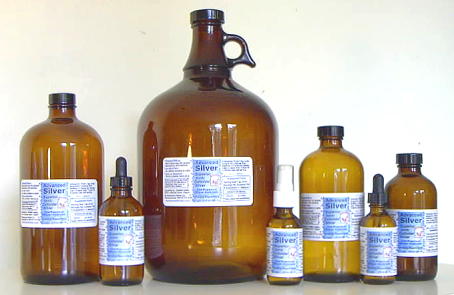
Safe Ionic Colloidal
Silver Water, 10 ppm*
Advanced Silver is
available in dropper
bottles, spray bottles, and larger refill sizes. Safe used as
directed. (EPA*)| * These statements have not been evaluted by the Food & Drug Administration. Advanced Silver Company products are not intended to diagnose, treat, cure or prevent any disease. |